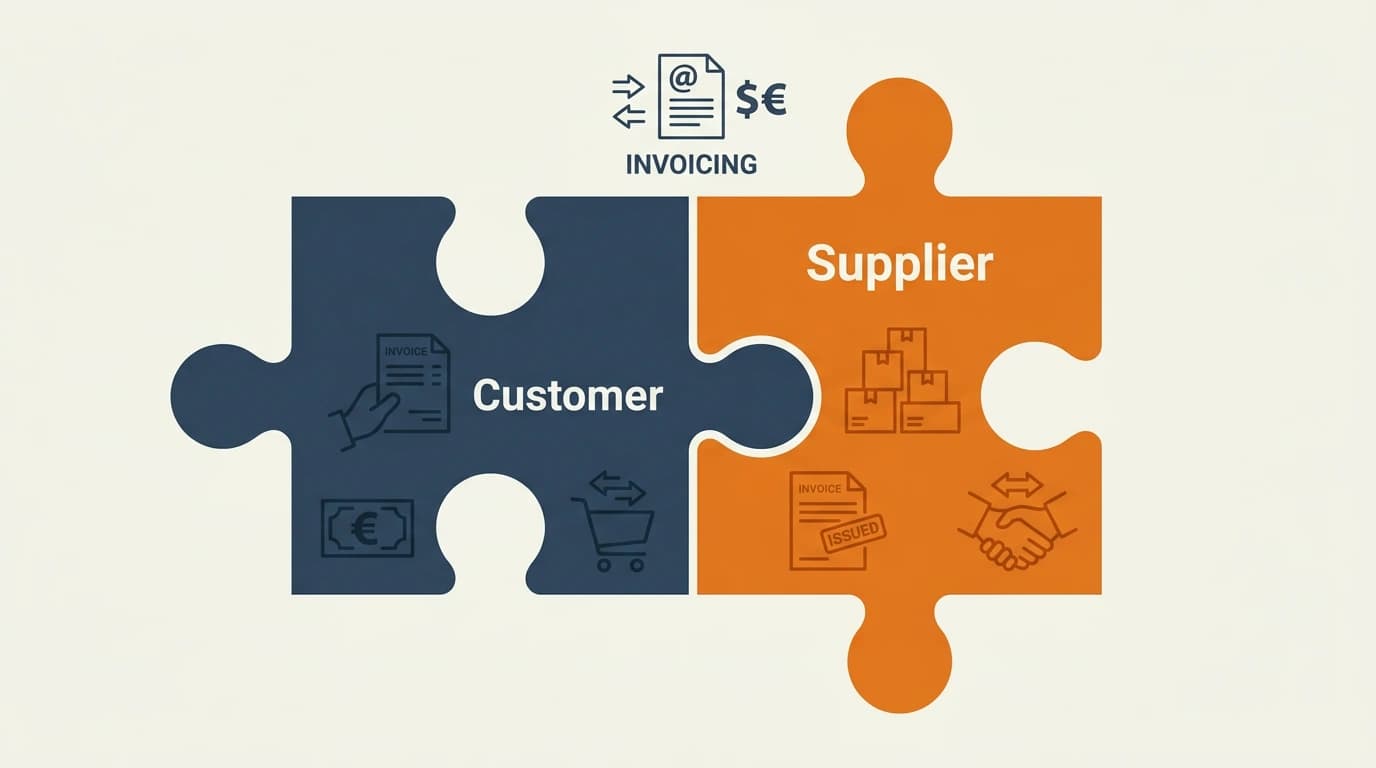
Self-billing (autofaturação) is a mechanism where the customer, rather than the supplier, issues the invoice on the supplier’s behalf. It is widely used in agriculture, recycling, recurring services and group structures, where the buyer holds better data on quantities, weights or prices than the seller. In Portugal, self-billing is permitted but tightly regulated under the Código do IVA (CIVA), and getting the formalities wrong can compromise the right to deduct input VAT.
What self-billing is
Under the standard rule, the supplier of goods or services is responsible for issuing the invoice. Self-billing reverses the operational burden: the acquirer prepares and issues the document, while the underlying transaction and the VAT liability still belong to the supplier. It is not the same as the reverse charge (autoliquidação), which shifts the obligation to account for the tax to the customer — the two concepts are frequently confused but are legally distinct.
Legal framework under the CIVA
The rules derive from the EU VAT Directive (2006/112/EC) and are transposed into Article 36 of the CIVA, complemented by Decreto-Lei n.º 28/2019 on invoicing and document-retention obligations. The CIVA allows a third party or the acquirer to issue invoices in the supplier’s name and on the supplier’s behalf, provided certain conditions are met.
Core conditions
- A prior written agreement between supplier and acquirer authorising self-billing.
- A procedure for the supplier’s acceptance of each document issued in its name (express or tacit, as defined in the agreement).
- The invoice must carry the mandatory mention “autofaturação” (self-billing).
- The supplier must be established and registered for VAT in Portugal, and supplier and acquirer should keep evidence of the arrangement.
All other invoicing requirements of Article 36 of the CIVA continue to apply, including dates, parties’ NIF, taxable amount, applicable rate and VAT amount, or the legal grounds for any exemption.
Operational procedures
1. Put the agreement in place
Before any document is issued, formalise a written self-billing agreement covering scope, the goods/services concerned, the acceptance mechanism, numbering, and how corrections (credit/debit notes) are handled.
2. Use certified software and respect numbering
Invoices must be produced through software certified by the Autoridade Tributária (AT), with sequential, gap-free numbering within the agreed series. Self-billed documents are typically issued in a dedicated series to keep them identifiable.
3. Communicate documents and SAF-T
Self-billed invoices feed the supplier’s records and must be reflected in the SAF-T (PT) reporting and in the e-Fatura system. Both parties need to ensure the documents are correctly attributed so the supplier’s output VAT and the acquirer’s input VAT reconcile.
4. Manage acceptance and corrections
The supplier should validate each document according to the agreed acceptance procedure. Errors are corrected through credit or debit notes that also reference the self-billing arrangement.
Practical takeaway: self-billing does not move the VAT liability to the buyer — the supplier remains the taxable person. What changes is who physically issues the invoice, and that only works if the written agreement, the “autofaturação” mention, certified software and an acceptance procedure are all in place.
Common pitfalls
- Confusing self-billing with reverse charge and mis-stating who accounts for the VAT.
- Omitting the “autofaturação” mention or the prior agreement, risking the supplier’s deduction or the document’s validity.
- Failing to register self-billed documents in SAF-T and e-Fatura on time.
How EasyFin helps
Self-billing only saves time if your invoicing, numbering series and SAF-T reporting stay consistent across both sides of the transaction. EasyFin helps expat entrepreneurs and SMEs in Portugal set up compliant invoicing flows, keep AT-certified documents in order, and coordinate with a certified accountant. Get started with EasyFin to structure your self-billing process correctly from day one.
Conclusion
Self-billing is a legitimate and efficient tool under the CIVA, but it is a formal arrangement, not an informal shortcut. With a proper written agreement, certified software, the right invoice mentions and reliable SAF-T reporting, both supplier and acquirer can rely on it with confidence. Because rates and procedural details can change, confirm your specific case with a certified accountant.
This article is provided for information purposes only and does not constitute professional, tax or legal advice. Always confirm your situation with a certified accountant (TOC/contabilista certificado).